There is no single price for tree removal in Philadelphia. Size, access, condition and urgency all change it — here is what actually sets the price, and how a safe removal works.
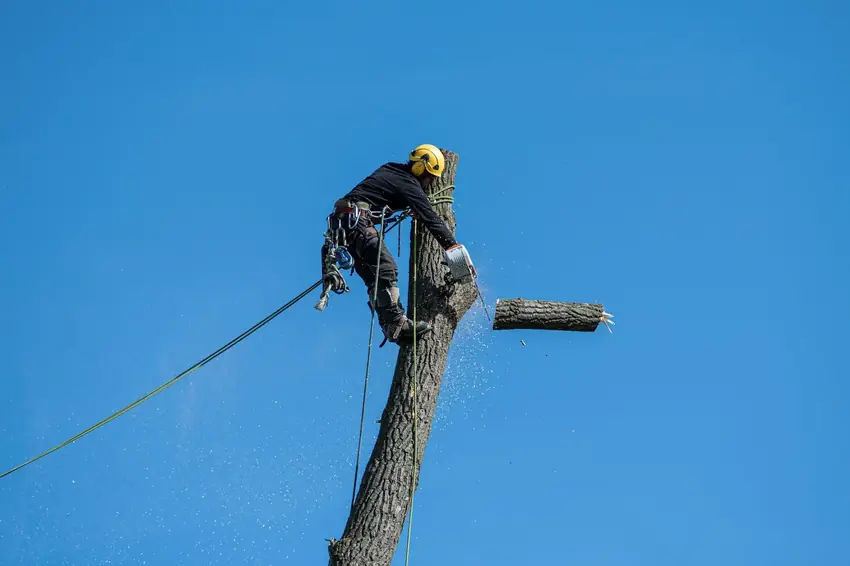
Ask five companies what tree removal costs in Philadelphia and you will get five different numbers, because there is no fixed price for the work. A small tree in an open front yard is a quick job: the crew can work from the ground, drop sections in a clear space, and chip everything on site. A tall oak between two rowhomes is a different job entirely — it has to come down piece by piece, with each section lowered by rope so nothing touches the roof, the fence, or the neighbour's yard, and that takes a bigger crew and more time. The tree's condition matters too: a dead tree is brittle and unpredictable, a leaning tree may need a crane, and a tree tangled in wires needs a crew that knows how to work around them. Access is the other big factor. If a truck and chipper can park in front of the house, the job moves fast; if everything has to come through a narrow alley, the crew plans for that and the price reflects it. The only honest way to know your price is a free on-site estimate, where we look at your tree, tell you exactly what the job involves, and give you a written number before any work starts. Our tree removal service covers the full scope, and the trimming guide explains when pruning can save a tree instead.
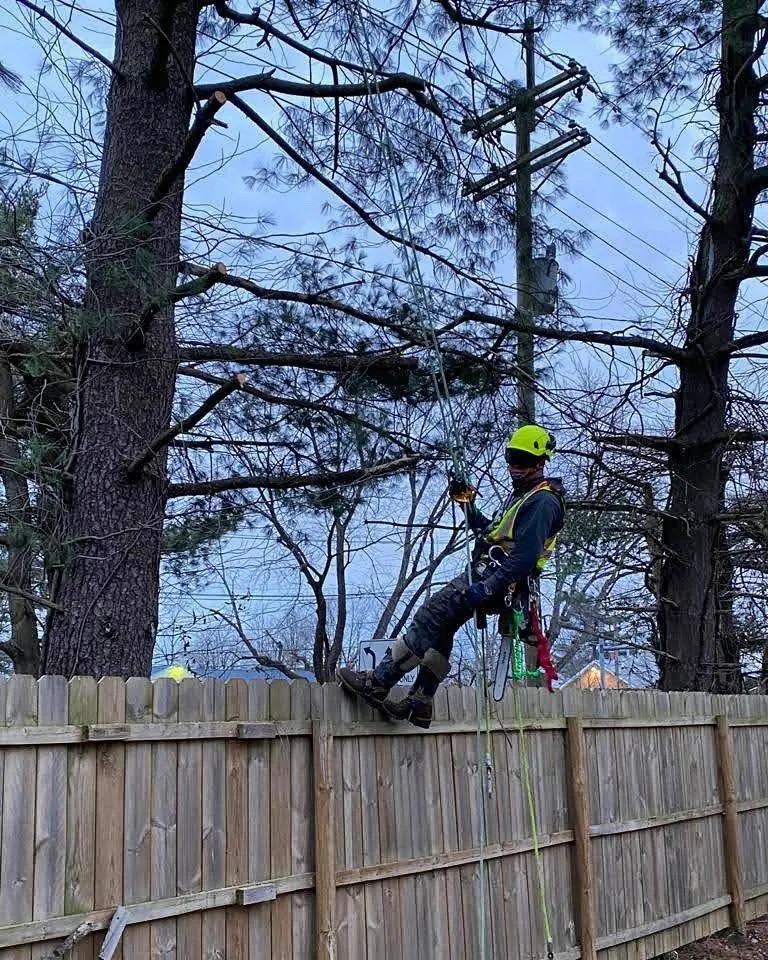
Most Philadelphia removals happen in yards with very little room to work, and that is where the method matters most. A tree in a rowhome backyard, or between two houses with only a narrow side passage, cannot simply be felled — there is nowhere for it to fall. Instead the crew works from the top down. A climber goes up on ropes, cuts a section, and lowers it to the ground on rigging lines while the ground crew guides it clear of the roof, the fence, and the garden beds. Larger limbs are cut in smaller pieces so nothing heavy falls uncontrolled. Where the tree is too large or too awkward to handle from ropes, a crane lifts sections out over the house. The work is planned before the first cut: the crew agrees on the order, the drop zone, and where the chipper and truck will sit, so the job moves steadily instead of stopping to improvise. That planning is what keeps your property safe, and it is the difference between a licensed, insured crew and someone with a chainsaw and a ladder. Philadelphia Tree Works LLC holds Commercial Activity License #1017327 and carries $1M in liability insurance.
Not every problem tree needs to come down, and a good crew will tell you when it does not. A tree with a few dead branches, or limbs overhanging the roof, usually needs trimming, not removal. A tree that is leaning at a new angle, has fresh cracks in the trunk, mushrooms growing at the base, or soil lifting around the roots is a different story — those are signs the root system is failing, and the tree is telling you it is about to go over. A dead tree, a hollow tree, or a tree with two trunks splitting apart at the base are also candidates for removal, because they are the ones that fail first in a storm. So is a healthy tree that has simply outgrown its spot: roots lifting a sidewalk, a trunk pressing against a foundation, or a canopy that has grown into power lines. If you are unsure, a free estimate is the right place to start. We will look at the tree, explain what we see in plain language, and tell you honestly whether it can be saved with pruning and cabling, or whether removal is the safe choice.
Removal does not end when the tree hits the ground, and a quote that leaves the mess behind is not a complete quote. Branches are chipped on site or loaded for haul-away the same day, trunk sections are cut to a size the truck can take, and the yard is raked before the crew leaves. The stump is a separate decision: it can be left, ground below grade so the area can be seeded or paved over, or removed entirely. Stump grinding is quoted in the same estimate so you know the full scope before work starts, and through December 31, 2026 it is free with any tree removal. Debris is part of the same visit where possible — our tree debris removal covers branches, logs and storm mess left over from other jobs too. When you compare quotes, check that cleanup is included: a cheap price that leaves you with a pile of wood to deal with yourself is not a bargain.
The right company for tree removal in Philadelphia is not the cheapest quote on the phone — no honest price can be given without seeing the tree. Look for a crew that insists on an on-site estimate, gives you a written scope and price before work starts, and explains the method for your yard, not just the price. Check that they are licensed and insured, and ask what happens to the debris and the stump. Ask how they will protect your roof, fence and garden beds, and what equipment they will bring. Be wary of anyone who wants to fell a tree in a tight yard, or who cannot tell you how they will lower it safely. A professional crew plans the job, rigs every section down, and cleans up before leaving. If you want that for your tree, call (267) 784-3424 for a free estimate, or use the form below and we will come and look at your tree in person. We serve Northeast Philadelphia, Germantown, Mount Airy, Chestnut Hill, Roxborough, Rhawnhurst, Manayunk and the rest of the city.
We serve Northeast Philadelphia, Fox Chase, Bustleton, Olney, Germantown, Mount Airy, Chestnut Hill, Roxborough, Manayunk, and Rhawnhurst.
There is no fixed price — it depends on the size of the tree, its condition, access to your yard, and what equipment is needed. A free on-site estimate is the only way to know your price, and we give you that written number before any work starts.
Most residential removals take half a day to a full day. A small tree in an open yard can be done in a few hours; a large tree in a tight yard, or one that needs a crane, takes longer. The estimate visit will tell you how long your job should take.
Yes. Branches are chipped or hauled away the same day, trunk sections are removed, and the yard is raked before the crew leaves. Cleanup is included in the estimate — stump grinding is quoted in the same estimate.