A tree on your roof or blocking your driveway cannot wait until Monday. We answer around the clock for storm damage, fallen trees, and trees that are about to come down.
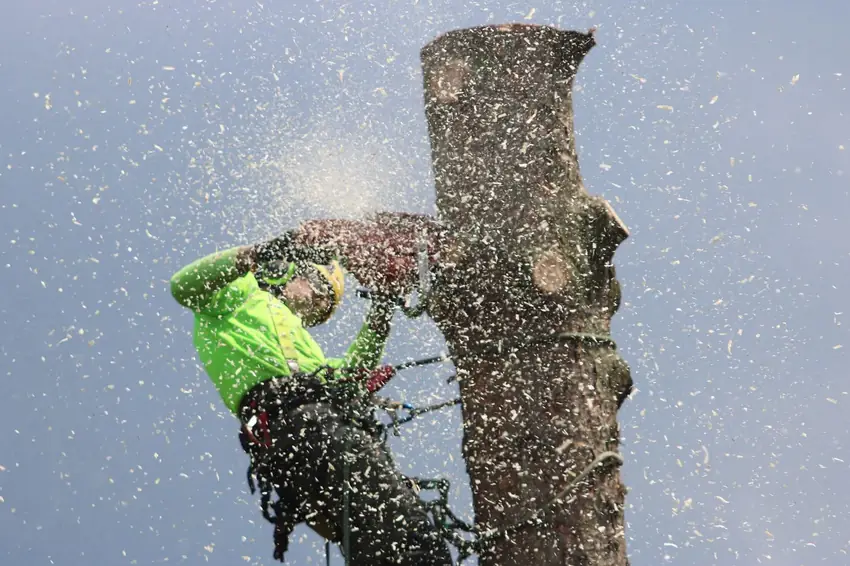
Not every tree problem is an emergency, but some cannot wait. A tree that has fallen onto a house is an emergency — it may be pressing on the roof structure, and every hour it sits there increases the risk of water getting in or the roof giving way. A tree leaning at a new angle after a storm, or one with fresh cracks in the trunk and roots lifting out of the soil, is an emergency too, because it is telling you it is about to go over. A large limb hanging by a strip of bark over a driveway or sidewalk is an emergency for the same reason. Emergency tree service in Philadelphia covers all of these: we make the situation safe first, then remove the tree or the damaged part, then clean up. A dead branch over a lawn, on the other hand, is urgent but not an emergency — it still needs a crew, just not at 2 a.m.
The first hour after a tree falls matters, and the right moves are simple. First, stay away from the tree. A fallen tree can shift, and a leaning tree can come down without warning. Do not try to cut it yourself — a tree under tension can spring back or roll when a cut is made, and that is how people get hurt. Second, if any power lines are involved, stay well clear and call your utility; never touch a line or a branch resting on one. Third, take photos from a safe distance for your insurance claim, and note the time and the weather. Then call us at (267) 784-3424. We will ask where the tree fell, what it is resting on, and whether anyone is hurt or the house is open to the weather, and we will tell you honestly how soon we can be there. Our guide on what to do when a tree falls walks through the same steps in more detail.
Emergency work is still careful work — speed does not mean shortcuts. When the crew arrives, the first job is to make the area safe: checking what the tree is resting on, whether the trunk is under tension, and where people and property are. If the tree is on a roof, sections are cut and lowered by rope so nothing else is damaged; a crane is brought in when the tree is too large or too awkward to handle from the ground. Branches are removed first to take weight off the trunk, then the trunk is cut in manageable sections and hauled away. Only after the tree is off the structure do we deal with the stump and the debris. The whole job is done by a licensed and insured crew — Philadelphia Tree Works LLC holds Commercial Activity License #1017327 and carries $1M in liability insurance — because emergency work is exactly when insurance matters most. We also handle storm damage cleanup and tree debris removal as part of the same visit where possible.
In many cases, yes — but the rules depend on your policy, so treat this as a guide, not a promise. Most homeowners policies cover removing a tree that has fallen on a covered structure, such as your house or garage, and cover the damage it caused. A tree that fell in your yard without hitting anything is usually not covered for removal, though the damage it caused to a fence or shed may be. The steps that help your claim are the same in every case: take photos before anything is moved, keep the invoice and any written estimate, and call your insurer as soon as the situation is safe. We can provide a written scope of the work and an itemised invoice for your claim. One thing to avoid: do not wait for an adjuster before making the tree safe. Insurers expect you to prevent further damage — a tree left on a leaking roof for a week is a bigger claim than a tree removed the same night.
The best emergency is the one that never happens, and most tree emergencies give warning first. A tree that has started leaning, even slightly, is the clearest sign. So are large dead branches, cracks running down the trunk, mushrooms or fungus growing at the base, and soil that has lifted or cracked around the roots — all signs the root system is failing. Trees with two trunks splitting apart at the base, or a canopy that is dead on one side, are also at higher risk in a storm. If you see any of these, do not wait for the next storm to test them. A free estimate costs nothing and tells you whether the tree can be saved with trimming and cabling, or whether dead tree removal is the safe choice. Regular trimming every few years is the cheapest insurance a tree owner can buy: it takes weight and wind resistance out of the canopy before a storm does it for you.
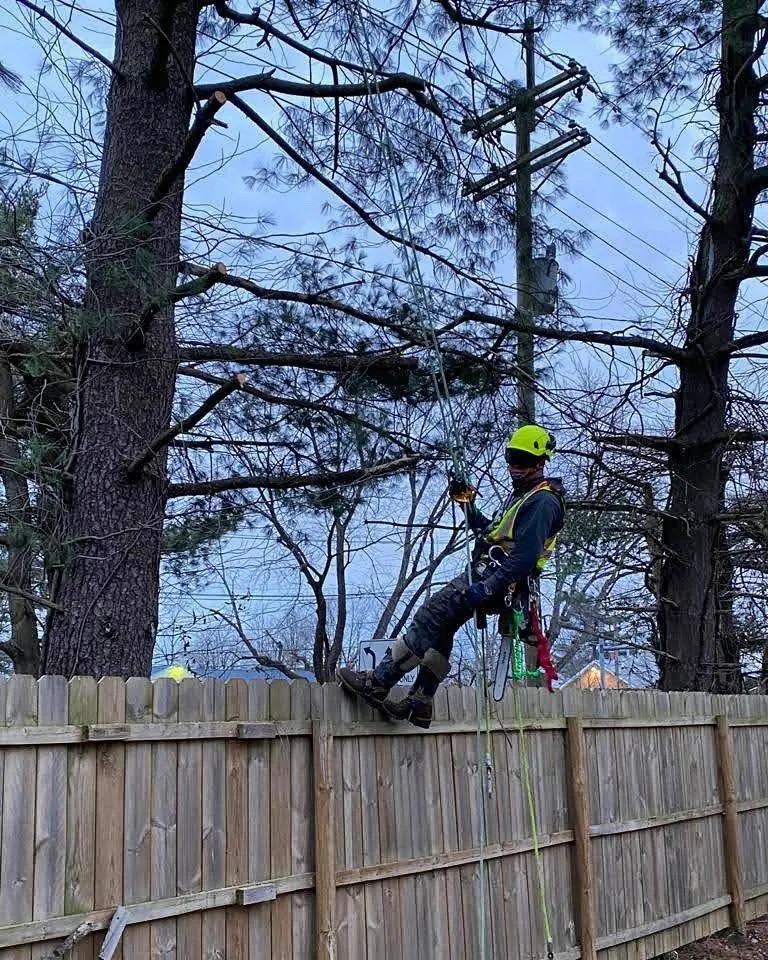
We serve Northeast Philadelphia, Fox Chase, Bustleton, Olney, Germantown, Mount Airy, Chestnut Hill, Roxborough, Manayunk, and Rhawnhurst.
Yes. Emergency tree service is a 24/7 service. If a tree has fallen on your house or is about to, call (267) 784-3424 at any hour — if we cannot come immediately, we will tell you when we can and what to do until then.
Make the situation safe first, then call your insurer. Take photos before anything is moved, keep our invoice, and report the claim as soon as you can. Do not wait for an adjuster before removing a tree that is letting rain into your house.
There is no fixed price — it depends on the size of the tree, where it fell, and what equipment is needed. We give you a written price for your specific job before work starts, and the estimate visit for the work is free. No price can be given honestly over the phone without seeing the tree.